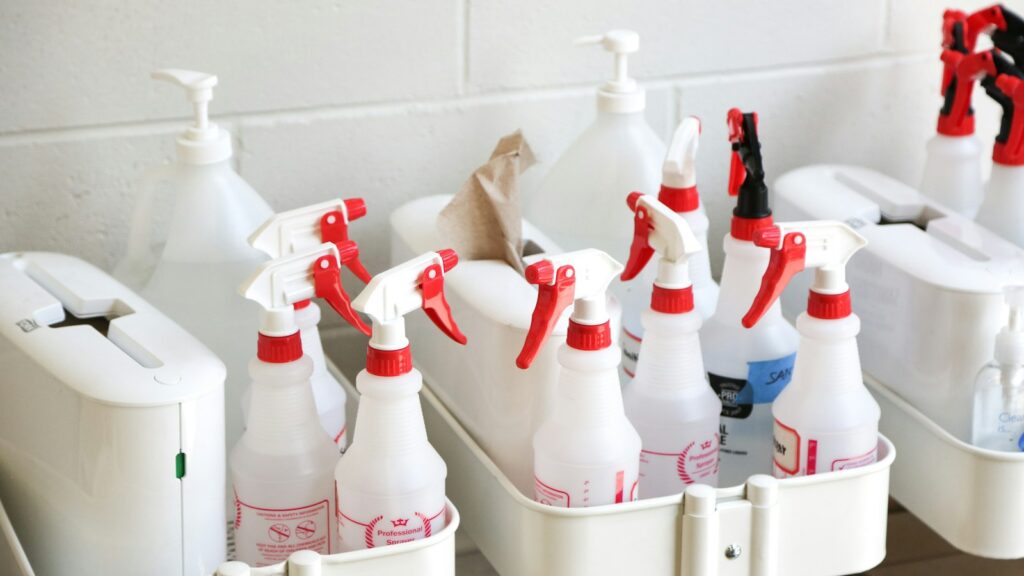
An estimated 16,000 UK workers each year report skin problems caused or worsened by work, with cleaners listed among the highest-risk occupations (HSE). The chemicals that keep your office spotless can burn skin, irritate lungs, and cause long-term health damage when handled incorrectly.
COSHH – the Control of Substances Hazardous to Health Regulations 2002 – exists specifically to prevent this. If you employ cleaners, hire a cleaning company, or store any cleaning products on your premises, COSHH applies to you. Not just to the cleaners. To you as the employer or building manager.
This guide cuts through the jargon. Here’s what COSHH actually requires, what your cleaning provider should be doing, and how to check you’re compliant before the HSE does it for you.
TL;DR: COSHH requires every business to assess, control, and monitor exposure to hazardous substances – including standard cleaning chemicals like bleach, toilet cleaner, and degreasers. You need written risk assessments, proper storage (locked, labelled COSHH cabinets), trained staff, and safety data sheets for every product on site. HSE fines for COSHH breaches start at £4,000 and can reach six figures (HSE, 2025).
What Is COSHH and Why Does It Apply to Cleaning?
The Control of Substances Hazardous to Health Regulations 2002 place a legal duty on employers to protect workers (and others) from health risks caused by hazardous substances at work (HSE). That includes cleaning chemicals.
Think about what’s under your office sink right now. Bleach. Toilet cleaner. Degreaser. Multi-surface spray. Floor polish. Every one of these is classed as a hazardous substance under COSHH. The white spirit your window cleaner uses? Hazardous. The limescale remover in the toilets? Corrosive.
Who has the duty?
Here’s where Manchester businesses often get confused. COSHH duties fall on:
- You, the employer – if you have in-house cleaners
- Your cleaning company – for substances they bring onto your site
- Both of you – for substances stored on your premises that either party uses
This means even if you outsource all cleaning, you still have responsibilities. Your cleaning company handles their own COSHH assessments. But you must ensure they’re doing it properly, and you need to know what chemicals are being used in your building.
Our finding: In our experience, roughly half the Manchester businesses we’ve started working with couldn’t tell us what cleaning chemicals the previous contractor was using – let alone produce a COSHH assessment for them. That’s a compliance gap the HSE can fine you for, even though you weren’t the one using the chemicals.
What Does a COSHH Risk Assessment for Cleaning Involve?
Frequent exposure to soaps, cleaners, and wet work accounts for over a quarter of all work-related contact dermatitis cases in the UK (HSE). A COSHH risk assessment is the legal mechanism for identifying and controlling these risks before someone gets hurt.
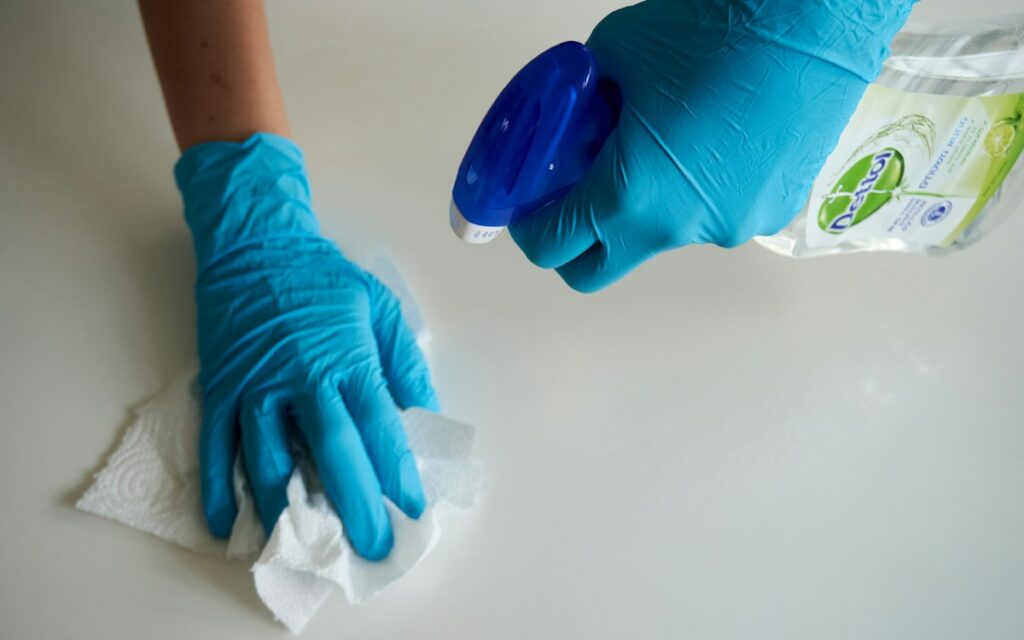
The HSE sets out five steps:
Step 1: Identify the hazardous substances
List every cleaning product used on your premises. Check the label for hazard symbols (the red diamond pictograms under the CLP system) and read the Safety Data Sheet (SDS) for each product.
Common cleaning chemical hazards:
- Bleach (sodium hypochlorite) — skin/eye irritation, toxic fumes if mixed — CLP: Corrosive, Environmental
- Toilet cleaner (hydrochloric acid) — burns, corrosive to skin and eyes — CLP: Corrosive, Acute Toxicity
- Degreaser (alkaline-based) — skin irritation, eye damage — CLP: Irritant, Corrosive
- Glass cleaner (ammonia-based) — respiratory irritation — CLP: Irritant
- Floor stripper (solvent-based) — flammable, harmful vapours — CLP: Flammable, Health Hazard
- Limescale remover (phosphoric acid) — corrosive, burns — CLP: Corrosive
Step 2: Decide who might be harmed and how
Consider your cleaners (direct exposure), office staff (residual fumes, wet floors), visitors, and anyone with pre-existing conditions like asthma or eczema.
Step 3: Evaluate the risks and decide on precautions
Can you eliminate the hazard? Switch to a less hazardous product? If not, what controls are needed – ventilation, PPE, training, time limits?
Step 4: Record your findings
You must write it down. A verbal agreement isn’t a COSHH assessment. Keep your assessments accessible to anyone who needs to see them – not locked in a filing cabinet.
Step 5: Review and update regularly
COSHH assessments aren’t one-and-done. Review whenever you change products, processes, or premises. The HSE expects annual reviews as a minimum.
full office cleaning checklist
How Should Cleaning Chemicals Be Stored Under COSHH?
The 2025 COSHH cabinet regulations require hazardous substances to be stored in appropriate cabinets that are clearly labelled, lockable, and positioned away from high-traffic areas and potential ignition sources (HSE). Getting storage right isn’t optional – it’s one of the first things an HSE inspector checks.
COSHH storage checklist
- Lockable cabinet or cupboard – not under the kitchen sink, not in a cardboard box
- Clearly labelled with COSHH hazard signage
- Away from food preparation areas (kitchens, breakrooms)
- Away from heat sources and direct sunlight
- Well-ventilated (or in a ventilated cupboard)
- Spill containment – trays or bunded shelving to catch leaks
- No mixing incompatible products on the same shelf (bleach and acids must be separated)
- Safety Data Sheets kept with or near the cabinet – accessible to all staff
What about cleaning trolleys?
Products on a cleaning trolley during use are fine. But they can’t live on the trolley overnight or between shifts. Everything goes back in the COSHH cabinet when the job’s done.
From our team: We issue every cleaner a laminated COSHH card that lists what’s in their trolley, the hazard class of each product, and what to do if there’s a spill or skin contact. It fits in a pocket and means nobody has to remember which product needs gloves and which doesn’t.
What PPE Do Cleaners Need Under COSHH?
About 53% of work-related contact dermatitis cases are allergic in nature, and 60% are caused by irritant exposure (HSE). PPE is the last line of defence – you should eliminate or substitute hazards first – but for cleaning work, some PPE is non-negotiable.
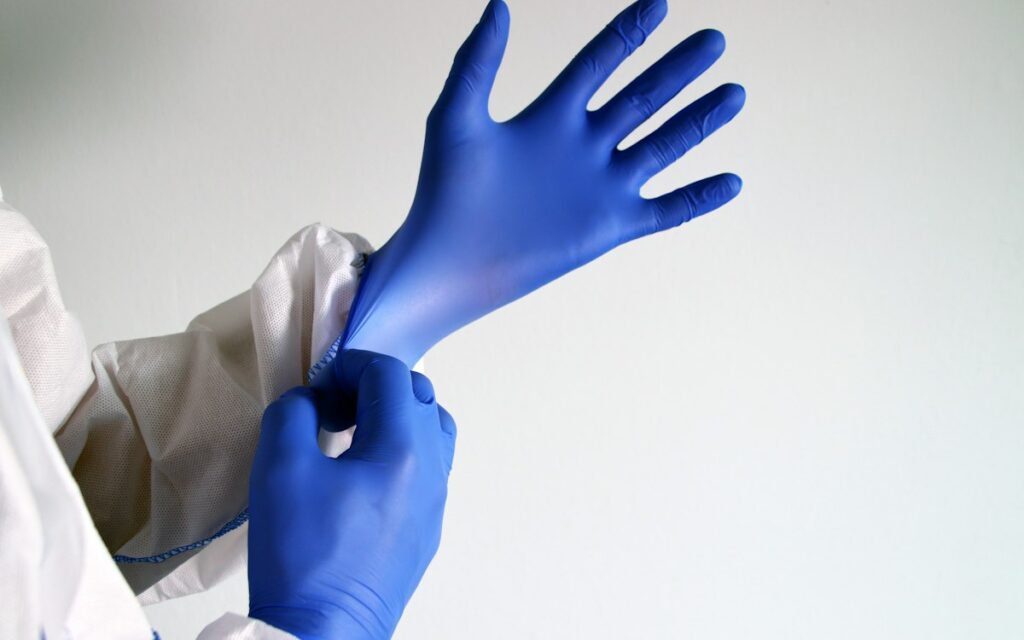
Essential PPE for commercial cleaning
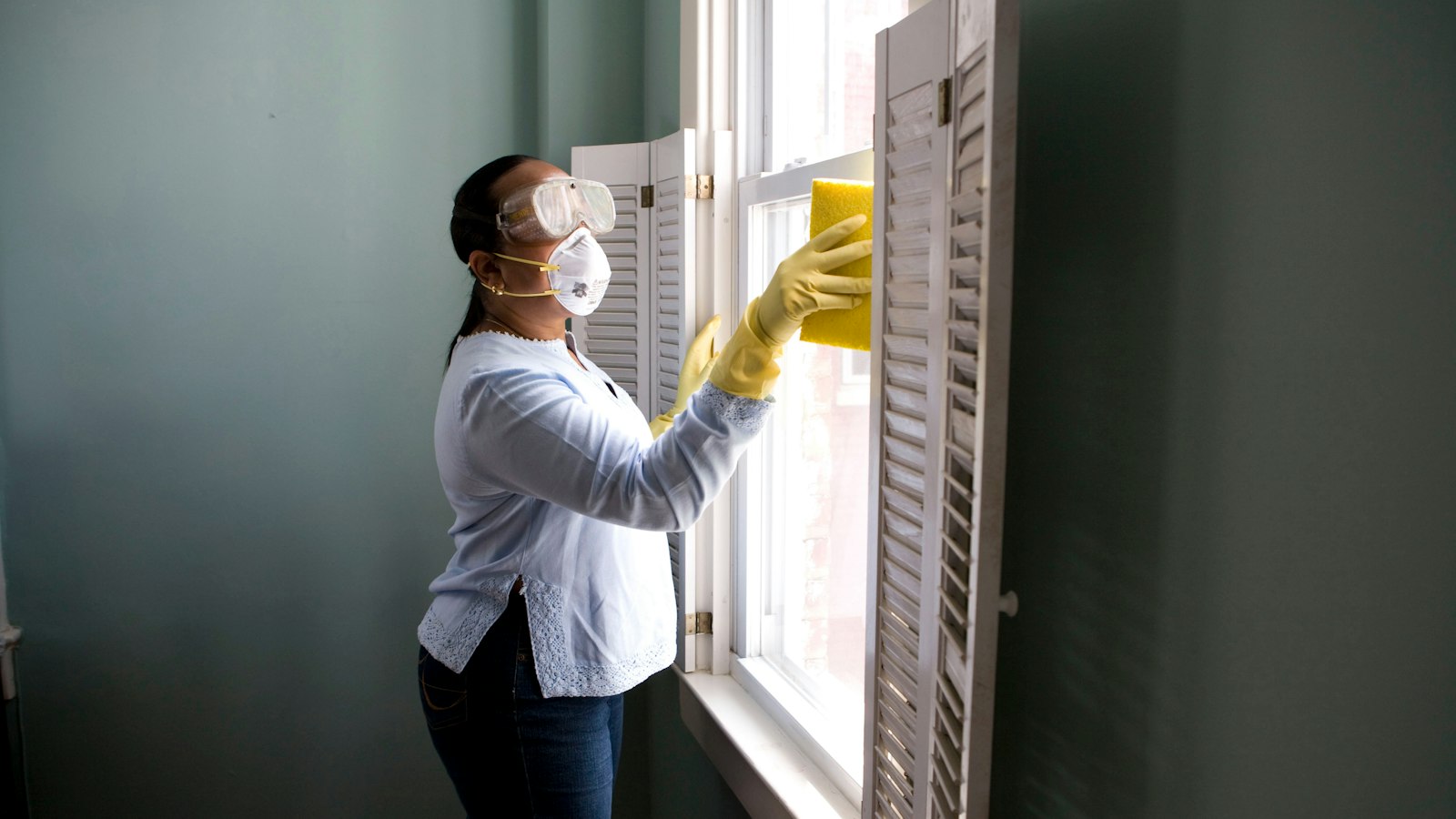
- General surface cleaning — minimum PPE: nitrile gloves — skin protection from detergents
- Toilet cleaning (acid-based products) — minimum PPE: nitrile gloves + eye protection — acid burns, splash risk
- Floor stripping (solvent-based) — minimum PPE: gloves + safety goggles + apron — flammable, skin/eye damage
- Using bleach or chlorine products — minimum PPE: gloves + eye protection — fumes, corrosive splashes
- Mixing chemicals (if ever required) — minimum PPE: full face shield + gloves + apron — never mix bleach with acids
- High-dust tasks (vacuuming without HEPA) — minimum PPE: FFP2 mask — dust inhalation
The golden rule: never mix chemicals
Bleach + acid-based toilet cleaner = chlorine gas. This isn’t hypothetical. It happens in offices, care homes, and schools when untrained cleaners mix products to “make them stronger.” One of the simplest COSHH controls is training every cleaner to never combine products and to never decant chemicals into unlabelled containers.
The 8 COSHH Essentials for Cleaning Operations
Source: HSE COSHH Regulations 2002
Written COSHH assessment for every product on site
SDS for every chemical, accessible to all staff
Locked, labelled COSHH cabinet away from food areas
Correct gloves, goggles, aprons for each task
Competency-assessed, not just attendance-logged
CLP-compliant labels on all containers – never decant unlabelled
Skin checks and health monitoring for exposed workers
Update assessments when products, processes or premises change
What Training Do Your Cleaners Need?
From 2025, the HSE expects objective competency assessment – not just documenting that someone attended a training session (Health and Safety Compliance). Your cleaners must be able to demonstrate they understand the hazards they work with, not just sign a sheet.
Minimum COSHH training should cover
- What COSHH is and why it exists (keep it simple – 10 minutes)
- How to read a product label – hazard symbols, signal words, precautionary statements
- How to read a Safety Data Sheet – sections 2 (hazards), 4 (first aid), 7 (handling/storage), 8 (PPE)
- When and how to use PPE – which gloves for which product, when goggles are needed
- What to do in an emergency – spills, splashes, inhalation, skin contact
- Why never to mix chemicals – with specific examples (bleach + acid = chlorine gas)
- How to report problems – skin irritation, respiratory symptoms, faulty equipment
How to assess competency
Don’t just ask cleaners to sign a form. Use: – Practical observation – watch them handle products, store chemicals, put on PPE – Short verbal quizzes – “What would you do if this product splashed in your eye?” – Spot checks – are they actually wearing gloves? Is the COSHH cabinet locked?
Record the assessment. Keep the records. The HSE wants evidence of competency, not just attendance.
What Happens When Cleaning Products Cause a Health Issue?
Occupational dermatitis affects an estimated 1.8 per 10,000 workers, making it the second most prevalent occupational health concern (HSE). If a cleaner or staff member develops a health problem linked to cleaning chemicals, you have legal obligations.
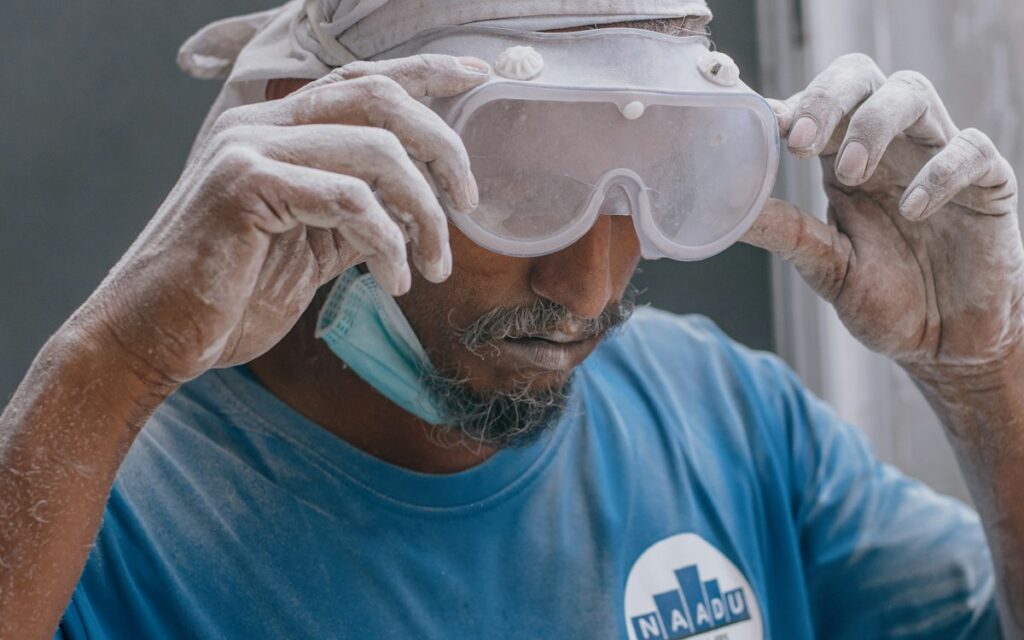
Immediate steps
- Remove the person from exposure – stop the task, move to fresh air if fumes are involved
- Administer first aid – follow the product’s Safety Data Sheet (Section 4)
- Record the incident in your accident book
- Report to RIDDOR if the condition is diagnosed by a doctor as occupational (reportable diseases include occupational dermatitis and occupational asthma)
Longer-term obligations
- Review your COSHH assessment – clearly something wasn’t controlled
- Consider switching products – can you achieve the same result with something less hazardous?
- Increase health surveillance – regular skin checks for cleaners using irritant products
- Inform your cleaning provider if the incident involves their staff or products
Our approach: Every Atlon cleaner undergoes a skin health baseline check before they start working with chemicals. We photograph hands at induction and review monthly. If we spot any changes – redness, drying, cracking – we switch products or adjust their PPE before it becomes a problem. Prevention is cheaper than compensation.
How Should Manchester Businesses Audit Their COSHH Compliance?
HSE fines for COSHH breaches have ranged from £4,000 for small companies to six-figure sums for serious failures (HSE, 2024-2025). A self-audit costs nothing and takes about an hour. Here’s how to check your own compliance.
COSHH compliance self-audit checklist
Documentation (check you have these): – [ ] Written COSHH risk assessment for every cleaning product on site – [ ] Safety Data Sheets for every product (current versions, not outdated) – [ ] Training records showing competency assessment (not just attendance) – [ ] RIDDOR reports for any chemical incidents – [ ] Health surveillance records (if applicable)
Storage (physically check): – [ ] COSHH cabinet is locked when not in use – [ ] Cabinet is clearly labelled with COSHH signage – [ ] Incompatible chemicals are separated (acids away from bleach) – [ ] No chemicals stored in food preparation areas – [ ] No unlabelled containers anywhere on site – [ ] Spill containment in place
Practice (observe your cleaners): – [ ] Cleaners wearing correct PPE for each task – [ ] Products used according to manufacturer instructions – [ ] No mixing of chemicals – [ ] Products returned to COSHH cabinet after use – [ ] Cleaners know where to find SDS in an emergency – [ ] First aid kit stocked with eye wash and burn dressings
Score yourself. If you’ve ticked everything, you’re in good shape. If you’ve missed more than three items, you’ve got work to do before an HSE inspector arrives.
evaluate your cleaning provider
COSHH Penalties: What Non-Compliance Can Cost You
Source: HSE Register of Prosecutions and Sentencing Guidelines, 2024-2025
Directors can face personal criminal prosecution for serious failures
What Should Your Cleaning Provider Handle for COSHH?
If you use an external cleaning company (and most Manchester businesses do), your provider should be managing the bulk of COSHH compliance for the products they bring to your site. Here’s what to expect from a competent cleaning contractor.
Your cleaning provider should supply
- COSHH risk assessments for every product they use in your building
- Safety Data Sheets for all their chemicals (on request, immediately – not “we’ll email it next week”)
- Evidence of staff training with competency assessments
- A product list detailing exactly what’s used and where
- Insurance covering chemical incidents (public liability and employer’s liability)
- Spill response procedures specific to your building
- A named supervisor you can contact with COSHH queries
Your responsibility as the client
Even with an external provider, you’re still responsible for: – Ensuring COSHH assessments have been completed (ask to see them) – Providing a suitable COSHH storage area if chemicals are kept on-site overnight – Reporting any chemical incidents that occur in your building – Allowing access for cleaning operatives to first aid facilities
Don’t assume your cleaning company has everything covered. Ask the questions. Check the paperwork. A good provider won’t mind. They’ll welcome it – because they’ve already done the work.
commercial cleaning services in Manchester
Frequently Asked Questions
Do I need COSHH assessments if I outsource all my cleaning?
Yes. Even if your cleaning company brings all their own products, you must ensure COSHH assessments exist for chemicals used on your premises. The HSE holds both parties responsible. Ask your provider for copies of their assessments and keep them on file. Over 16,000 UK workers report work-related skin problems annually (HSE) – don’t assume someone else has it handled.
What’s the most common COSHH mistake in office cleaning?
Mixing chemicals. Specifically, bleach (sodium hypochlorite) combined with acid-based toilet cleaners produces chlorine gas, which can cause serious respiratory harm. The HSE’s guidance for cleaners lists this as a primary risk (HSE). Train every cleaner – and label every product clearly – to prevent accidental mixing.
How often should COSHH assessments be reviewed?
The HSE recommends reviewing COSHH assessments at least annually and whenever you change products, processes, or premises. From 2025, inspectors are looking for evidence that reviews actually happened – a date on the document and a named reviewer. cleaning checklist with review schedule
Can I be fined if my cleaning contractor breaches COSHH?
Yes. If a contractor’s breach occurs on your premises and you haven’t taken reasonable steps to check their compliance, the HSE can take enforcement action against you. Fines for small companies start around £4,000 (HSE). Due diligence means asking for assessments, checking storage, and confirming training records before the contract starts.
What PPE should my cleaners always have?
At minimum, nitrile gloves for all cleaning tasks. For acid-based products (toilet cleaners, limescale removers), add eye protection. For solvent-based products (floor strippers), add a waterproof apron. FFP2 masks for high-dust tasks. Your COSHH assessment dictates the specific PPE for each chemical – there’s no one-size-fits-all answer.
Get Your COSHH Compliance Right
COSHH isn’t optional, and it isn’t just paperwork. It protects your cleaners, your staff, and your business from preventable harm and avoidable fines.
Here’s what to do next:
- Ask your cleaning provider for copies of their COSHH assessments and SDSs. If they can’t provide them, that tells you everything you need to know.
- Walk your premises and check where chemicals are stored. Is there a locked, labelled COSHH cabinet? If not, fix it this week.
- Check training records. Can your cleaners demonstrate competency, or did they just sign a sheet?
At Atlon Cleaning Services, every product we use comes with a full COSHH assessment, and every cleaner we employ has passed a practical competency check. We’ll happily walk you through our compliance paperwork – because we think that should be standard, not a selling point.
Call us on 0161 524 9966 to discuss your cleaning needs, or get a free cleaning quote.