Office desks harbour 400 times more bacteria than a toilet seat. That’s 21,000 germs per square inch, according to research from the University of Arizona. Yet plenty of Manchester businesses still ask staff to wipe down their own desks.
Finding a reliable commercial cleaning provider shouldn’t be guesswork. Missed cleans. Inconsistent standards. Vague pricing. These are the complaints we hear most from businesses switching providers. This guide breaks down what commercial cleaning actually covers, what it costs in Manchester, and how to choose a provider that shows up and does the job properly.
Commercial cleaning in Manchester costs £20-£30 per hour for standard office maintenance. The UK building cleaning market hit £9.8 billion in 2026 (IBISWorld, 2026). Professional cleaning cuts workplace absenteeism by up to 46% (ISSA/Kimberly-Clark). Check insurance, COSHH training, and quality control before signing any contract.
Table of Contents
- What Does Commercial Cleaning Include?
- What Types of Businesses Need Commercial Cleaning?
- How Much Does Commercial Cleaning Cost in Manchester?
- What Are the Benefits of Professional Commercial Cleaning?
- How Do You Choose a Commercial Cleaning Company?
- What Should a Commercial Cleaning Contract Include?
- Why Is Manchester’s Commercial Cleaning Market Growing?
- Areas We Cover Across Greater Manchester
- Frequently Asked Questions
- How much does commercial cleaning cost per hour in Manchester?
- How often should a commercial property be cleaned?
- What is the difference between commercial and domestic cleaning?
- Do commercial cleaners work outside business hours?
- What insurance should a commercial cleaning company have?
- Can I get a one-off deep clean without a contract?
- Key Takeaways
What Does Commercial Cleaning Include?
A Staples workplace survey found that 94% of employees feel more productive in a clean work environment (Staples). Commercial cleaning covers all routine and specialist cleaning for business premises, from daily office maintenance through to periodic deep cleans and one-off projects.
Weekly Maintenance Cleaning
The bread and butter of any commercial cleaning contract. A standard weekly visit covers:
- Floors vacuumed and mopped
- Toilets and washrooms cleaned and disinfected
- Kitchen surfaces, sinks, and appliance exteriors wiped down
- Bins emptied and liners replaced
- Desks, reception areas, and communal spaces tidied
- Spot cleaning of marks on walls and doors
How often do you actually need cleaners in? Most offices book 2-5 visits per week depending on footfall. A small office with 10-15 staff might only need two. A busy call centre with 100+ people? That’s daily.
Monthly Deep Cleaning
This goes beyond the weekly routine. Deep cleans tackle the areas that build up grime over weeks:
- High-level dusting (light fittings, vents, tops of cupboards)
- Skirting boards and door frames
- Behind and under furniture
- Internal glass partitions
- Hard floor stripping and resealing (where needed)
- Carpet deep extraction
What most providers don’t tell you: Every competitor in Manchester lists “deep cleaning” as a service, but none break down what’s actually included versus a standard visit. Ask for an itemised task list before you sign anything. If a provider can’t give you one, that’s a red flag.
Specialist Services
Beyond routine maintenance, commercial cleaning also covers carpet cleaning, window cleaning (internal and external), end of tenancy cleaning, pressure washing, and biohazard or trauma cleaning for incidents that need specialist handling. If you’re not sure what level of service your premises need, a good provider will do a site visit and recommend a scope that fits your budget.
What Types of Businesses Need Commercial Cleaning?
Manchester’s office market saw 1.22 million square feet of take-up in 2024, 29% above 2023 levels (Savills, Q4 2024). Every one of those businesses needs some form of professional cleaning. But the scope varies hugely by sector.
Offices are the most common. Open-plan spaces, meeting rooms, kitchens, and washrooms all need daily or near-daily attention. Staff notice when standards slip.
Warehouses and industrial units need a different approach. Trafford Park alone houses hundreds of distribution and logistics businesses. Floor scrubbing, loading bay cleaning, and dust control are the priorities here.
Retail spaces need cleaning outside trading hours, often early morning. Display areas, fitting rooms, and shop floors take a battering from foot traffic.
Medical and dental practices have strict hygiene standards. Cross-contamination prevention and clinical waste handling go beyond a standard clean.
Schools and nurseries need child-safe products and methods. Term-time cleaning schedules differ from holiday deep cleans.
Gyms, restaurants, and hospitality venues each have their own requirements, from equipment sanitisation to kitchen extraction cleaning.
Why does this matter? Because the sector shapes everything — the specification, the equipment, and the scheduling. An office clean at 6pm looks nothing like a warehouse floor scrub at 5am in Trafford Park.
How Much Does Commercial Cleaning Cost in Manchester?
Standard commercial cleaning in Manchester costs £20-£30 per hour, or £1.50-£4.00 per square metre, depending on the size, frequency, and scope of work. That’s competitive compared to London, where rates regularly exceed £30-£45+ per hour.
Hourly vs. Square Metre Pricing
Most Manchester cleaners quote either an hourly rate or a rate per square metre. Here’s how they compare across major UK cities:
What Affects the Price?
Several factors push the cost up or down:
- Size of premises — larger spaces cost more in total but less per square metre
- Cleaning frequency — daily contracts get better rates than weekly
- Access hours — out-of-hours cleaning (before 7am or after 7pm) may carry a premium
- Specialist requirements — medical, food preparation, or industrial environments cost more
- Contract length — longer commitments often mean lower rates
A Real Pricing Example
Actual example from a Manchester office contract: A 2,500 sq ft office with 20 staff, cleaned 3 times per week (2 cleaners, 3 hours per visit) at £150 per week. Monthly deep clean at £200. Total monthly cost: approximately £800. That works out to £0.32 per square foot per week.
The National Living Wage rose to £12.21 in April 2025 (UK Government, 2025). That’s just the wage floor. Once you add employer’s NI, insurance, equipment, management, and profit, it’s impossible to deliver a quality service for less than £20 per hour. Any provider quoting significantly below that? It’s worth asking how they make the numbers work.
What Are the Benefits of Professional Commercial Cleaning?
Professional cleaning reduces workplace absenteeism by up to 46%, according to the ISSA and Kimberly-Clark Healthy Workplace Project (ISSA/Kimberly-Clark). That’s not a marginal improvement. For a 50-person office, it could mean dozens fewer sick days each year.
Health and Absenteeism
UK workers took an average of 9.4 sick days in 2025, nearly double pre-pandemic levels (The Access Group, 2025). Minor illnesses remain the top reason for short-term absence at 78%.
Regular professional cleaning attacks the root cause. Those 21,000 germs per square inch on the average desk don’t clean themselves. Phones, keyboards, door handles, and kitchen surfaces are breeding grounds for colds, flu, and stomach bugs.
Productivity and Focus
Research from the Harvard T.H. Chan School of Public Health found that clean workspaces improve cognitive performance by up to 20% (Harvard, 2024). Clutter and dirt are distractions. A clean environment helps people concentrate.
Employee Satisfaction
94% of employees say they feel more productive in a clean work environment (Staples). That matters for retention too. Nobody wants to work in a grimy office — and they won’t stick around if you don’t sort it out.
First Impressions and Compliance
Clients, customers, and visitors judge your business within seconds of walking through the door. A dirty reception area or grimy toilet tells them everything. And if you’re in a regulated sector — healthcare, food, education — cleaning isn’t optional. It’s a compliance requirement.
How Do You Choose a Commercial Cleaning Company?
There are 13,888 general building cleaning businesses in the UK (IBISWorld, 2025). Most are small operators. Many don’t have formal quality systems, written specifications, or proper insurance. So how do you tell the reliable ones from the cowboys?
The Five-Point Checklist
Before signing any contract, check these five things:
1. Insurance At minimum, your provider needs public liability insurance and employer’s liability insurance. Ask for certificates. The industry standard is at least £5 million public liability cover. If they can’t produce proof, walk away.
2. Staff vetting Are cleaners DBS-checked? Do they go through a proper induction? Your staff are sharing a building with these people, often outside office hours when nobody else is around.
3. COSHH training The Control of Substances Hazardous to Health regulations apply to every cleaning chemical. Trained cleaners know which products to use where, how to handle spillages, and how to store chemicals safely.
4. Written specification A proper cleaning company will give you an itemised task list for every visit. What gets cleaned, how often, and to what standard. If they can’t write it down, they can’t guarantee it.
5. Quality control How do they check the work? Supervisor site visits, client feedback forms, and an escalation process for complaints are the basics. Ask what happens when something gets missed.
What we’ve seen in practice: When we take over a contract from another provider, the most common issues are high-level surfaces that haven’t been touched in months and kitchen appliances that haven’t been cleaned internally. These are the tasks that get skipped when there’s no written specification or quality checks in place.
Ask for References
Any established provider should be able to give you 2-3 references from current clients. Call them. Ask about reliability, communication, and how problems get handled.
What Should a Commercial Cleaning Contract Include?
A proper cleaning contract specifies the tasks, frequency, hours, staff numbers, and quality measures in writing. Vague contracts lead to vague results. Here’s what to look for.
Contract Essentials
| Element | What it should say |
|---|---|
| Task list | Itemised checklist for each visit type (maintenance and deep clean) |
| Schedule | Days, start times, and estimated duration |
| Staff numbers | How many cleaners per visit |
| Deep clean scope | What’s included monthly vs. quarterly |
| Supervisor visits | How often and what they inspect |
| Escalation process | How to report issues and expected response time |
| Price review | When and how rates can change (usually annually) |
| Notice period | Typically 30-90 days for either party |
Red Flags
Watch out for contracts that don’t specify individual tasks, have no quality control mechanism, or lock you in for 12+ months without a break clause. A confident provider doesn’t need to trap you with long notice periods.
Why Is Manchester’s Commercial Cleaning Market Growing?
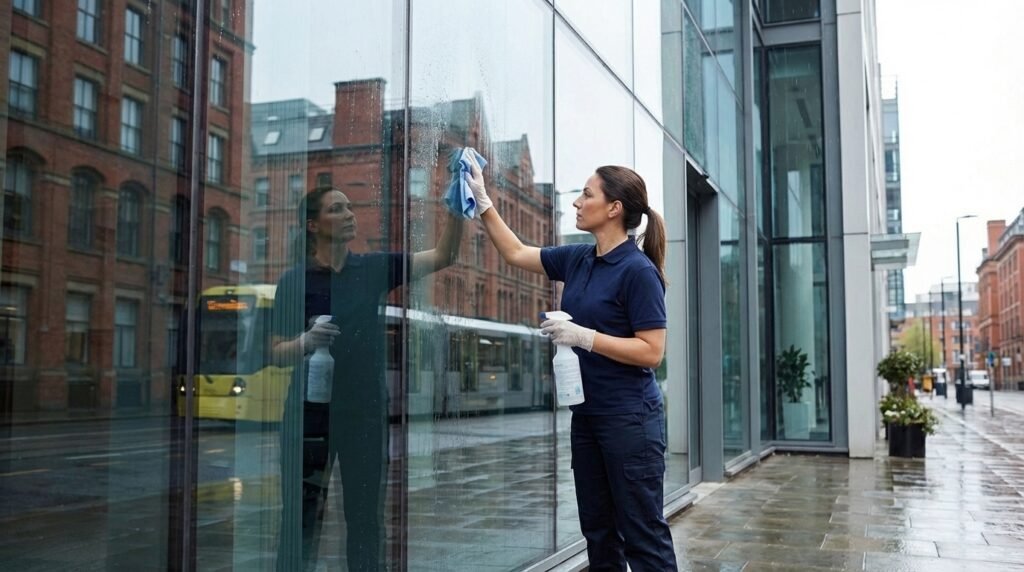
The UK general building cleaning industry is worth £9.8 billion in 2026, after growing at a compound annual rate of 5.6% over the past five years (IBISWorld, 2026). Manchester is driving a good share of that growth.
Manchester’s Office Boom
Office take-up in Manchester hit 1.22 million square feet in 2024, running 29% above 2023 (Savills, Q4 2024). Prime office rents climbed to £45 per square foot, up from £43 at the start of the year. More office space means more cleaning contracts.
The Return-to-Office Effect
Hybrid working hasn’t killed the office. It’s changed it. Businesses are investing more in their physical spaces to make them worth the commute. That means higher standards for cleanliness, better communal areas, and more frequent cleaning. If your office isn’t spotless, why would anyone come in?
Post-COVID Hygiene Expectations
Staff and visitors now expect hand sanitiser stations, regularly cleaned touchpoints, and visible cleaning schedules. What used to be a nice-to-have before 2020 is now the bare minimum.
The UK cleaning industry employs over 1,008,700 people (British Cleaning Council, 2024). It’s a massive sector, and demand in Manchester specifically is being fuelled by new office developments in the city centre, continued growth in Salford Quays and MediaCity, and the industrial corridor along Trafford Park.
Areas We Cover Across Greater Manchester
We provide commercial cleaning services across Manchester and surrounding areas, including:
- Manchester City Centre — offices, retail, and hospitality venues
- Salford – including Salford Quays, MediaCity, and Chapel Street developments
- Trafford – residential and commercial properties across the borough
- Trafford Park – warehouses, distribution centres, and industrial units
- Stretford – offices and community spaces
- Eccles – commercial properties and local businesses
- Swinton – residential and light commercial cleaning
- Wigan – offices, retail, and public sector buildings
- Urmston, Sale, and Altrincham – South Manchester commercial and residential
Whether you need deep cleaning services for a one-off project, an ongoing commercial cleaning contract, or residential cleaning for landlords and households, we’ve got Greater Manchester covered. Get in touch for a free quote.
Frequently Asked Questions
How much does commercial cleaning cost per hour in Manchester?
Standard commercial cleaning in Manchester costs £20-£30 per hour, depending on premises size, cleaning frequency, and specific requirements. Specialist services such as biohazard or clinical cleaning cost more. The National Living Wage of £12.21 (April 2025) sets the floor for cleaning labour, but rates reflect insurance, training, equipment, and quality control on top of wages.
How often should a commercial property be cleaned?
Most offices need cleaning 3-5 times per week, with a monthly deep clean added on top. Warehouses and industrial units typically need 1-2 visits per week with quarterly deep cleans. According to University of Arizona research, office desks accumulate 21,000 germs per square inch without regular cleaning.
What is the difference between commercial and domestic cleaning?
Commercial cleaning covers business premises — offices, warehouses, retail, and industrial sites. It uses industrial-grade equipment, follows COSHH regulations, and typically operates outside business hours. Domestic cleaning covers private homes using household products. The UK commercial cleaning sector employs approximately 450,000 people (British Cleaning Council).
Do commercial cleaners work outside business hours?
Yes. Most commercial cleaning in Manchester happens before 8am or after 6pm to avoid disrupting staff. Flexible scheduling during or after business hours is standard, including weekends for retail and hospitality clients. Early morning and late evening slots are the most popular.
What insurance should a commercial cleaning company have?
At minimum, public liability insurance and employer’s liability insurance. Check that the cover matches the value of your premises and contents. The industry standard is at least £5 million public liability. Ask for certificates before signing anything.
Can I get a one-off deep clean without a contract?
Yes. Many Manchester businesses book one-off deep cleans before audits, inspections, office moves, or lease handovers. One-off cleans are priced per job based on floor area and scope, not hourly rates.
Key Takeaways
- Commercial cleaning in Manchester costs £20-£30 per hour (standard) or £1.50-£4.00 per square metre
- A clean workplace cuts absenteeism by up to 46% and boosts cognitive performance by 20%
- Always check insurance, COSHH training, staff vetting, written specifications, and quality control before signing
- Manchester’s office market is growing fast — 1.22 million sq ft of take-up in 2024 alone
- Get everything in writing: task lists, schedules, deep clean scope, and escalation processes
Ready for a quote? Call us on 0161 524 9966 or request a free quote online. We’ll send you a written specification within 24 hours.